KSA FMCG: The $48B Opportunity
— and the Four Battles That Decide Who Wins
The Saudi consumer market is growing. But size is not strategy. Here is what the numbers, and the shelf, are actually telling us.
"In retail, growth in the market does not automatically translate into growth on your shelf. The brands that confuse the two pay for it in lost visibility, lost rotation, and ultimately, lost relevance."
— Saudi FoodTech · FMCG Market Intelligence, May 2026The Saudi FMCG market continues to prove its strength and resilience. From $36 billion in 2024 to a projected $48 billion by 2030 — a compound annual growth rate of approximately 5% — the fundamentals are compelling. Population growth, a young demographic base, rising household incomes, and the structural expansion of modern trade all point in the same direction.
But market size is not a strategy. And headline growth can mask the intensely competitive, execution-dependent reality that anyone operating on-ground in KSA retail knows well. The question is not whether the market is large. The question is what it actually takes to win inside it — on the shelf, in the category, and across the supply chain.
What we see on-ground points to four forces that are simultaneously creating opportunity and raising the cost of error: price sensitivity, promotion dependency, the rise of local preference, and the growing but still secondary role of e-commerce. Understanding each is the starting point for any serious trade and supply chain strategy in this market.
The Market Structure: Modern Trade Still Dominates
Despite years of growth in digital channels, 57% of FMCG sales in Saudi Arabia are still driven by modern trade — supermarkets, hypermarkets, and the expanding network of convenience-format retailers. This figure carries significant strategic weight: it means that shelf placement, planogram position, and in-store visibility remain the primary battleground for consumer preference.
The modern trade channel in KSA is not simply a distribution endpoint. It is the primary consumer touchpoint — the place where brand equity is tested weekly against lower-cost alternatives, private label ranges, and aggressive competitor promotions.
For FMCG brands, being listed is not the same as being chosen. The gap between the two is where most commercial performance is won or lost.
E-commerce is growing — and its trajectory over the next three to five years should not be underestimated, particularly among urban, younger demographics and in categories with high repeat purchase frequency. But it has not yet displaced physical retail as the dominant channel. Brands that over-pivot to digital at the expense of in-store excellence are making a bet the data does not yet support.
For any brand operating in KSA today, winning modern trade is not optional. It is the primary commercial objective. Everything else — digital, direct-to-consumer, foodservice — is complementary until modern trade share is secured.
Price Sensitivity and the Promotion Trap
Two structural realities define how KSA consumers are currently engaging with FMCG categories: sustained price sensitivity and high promotion dependency. These are not new dynamics, but their intensity has increased materially since 2022 — and the global context makes them worth examining carefully.
The risk with high promotion dependency is well-documented in mature FMCG markets: when a brand trains consumers to wait for promotions, it progressively undermines its own full-price velocity. The result is a calendar-driven volume pattern that looks healthy in aggregate but conceals declining baseline demand — and puts significant pressure on trade margins, supply chain planning, and forecasting accuracy.
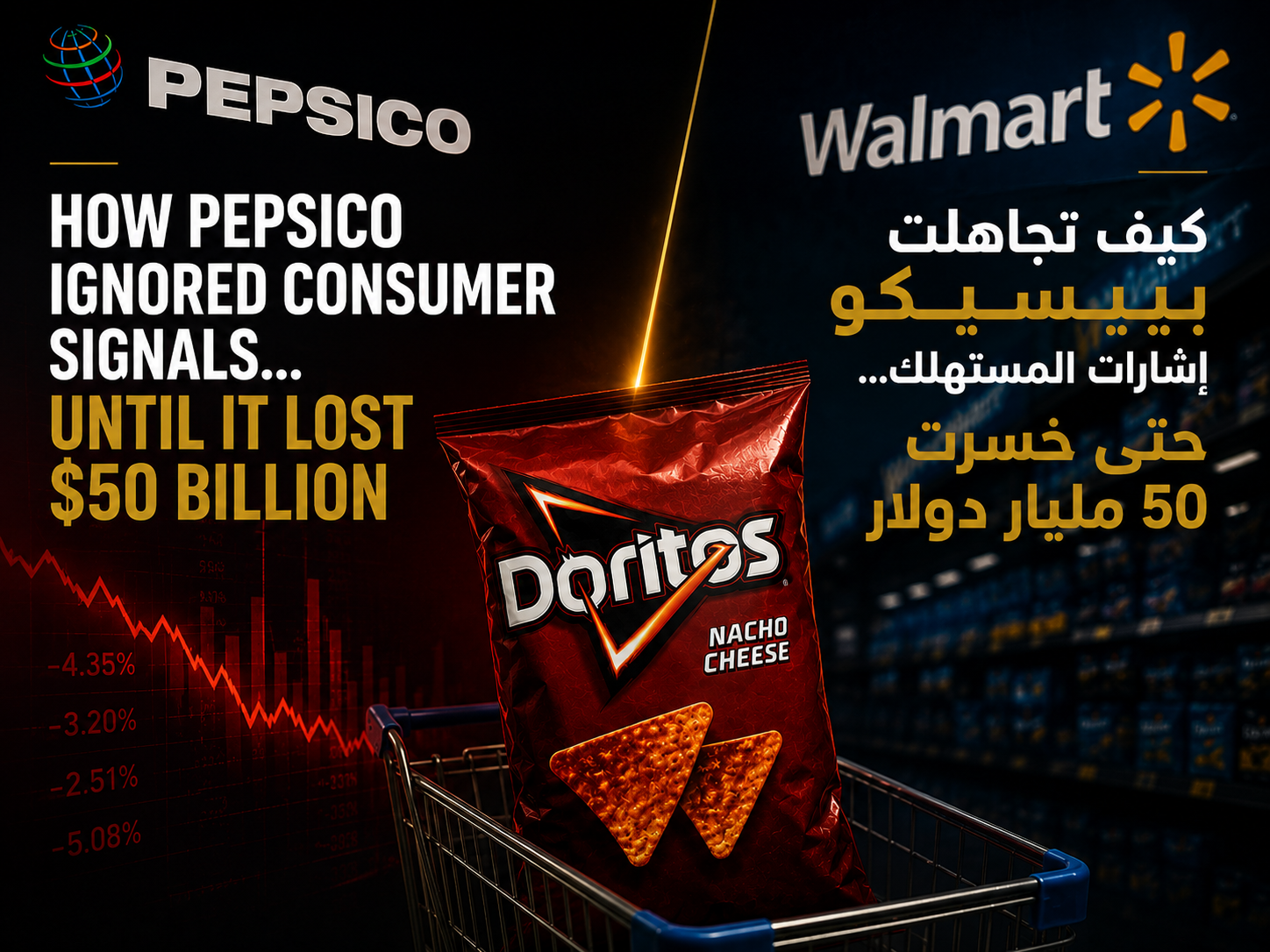
The global FMCG industry is currently processing one of its most costly pricing lessons. Between 2021 and 2025, PepsiCo raised Doritos prices by nearly 50% at major US retailers. In some stores, large bags exceeded $7. The company used price hikes to offset rising input costs — a strategy that worked briefly during the post-pandemic rebound, then stopped working entirely.
Frito-Lay's revenue had grown for 53 consecutive quarters. Then it turned negative, missing internal targets by more than a billion dollars two years running. Shoppers shifted to store brands and rivals. Walmart cut shelf space for Frito-Lay and handed more room to lower-cost competitors. By late 2025, PepsiCo's market value had collapsed by more than $50 billion from its 2023 peak. Price cuts of up to 15% followed in February 2026 — roughly 18 months after the market had already delivered its verdict.
The lesson is direct: price elasticity is not a finance metric. It is a supply chain and commercial signal. When retail partners signal prices are too high and shelf space begins to shrink, the market is speaking. The brands that hear it early win. The ones that delay pay the full cost.
In the KSA context, the pricing dynamic is different in degree — cost inflation has been less severe and consumer response patterns differ — but the underlying principle holds. Brands that rely on list price increases without commensurate perceived value delivery will lose velocity to private label and local competitors. And once shelf space is lost, the path back is long and expensive.
The Rise of Local: A Commercial Signal, Not a Trend
One-third of KSA consumers actively prefer locally-produced products. That number is not a soft cultural preference — it is a commercial signal that is reshaping how retailers allocate shelf space and how brands position their sourcing and provenance narratives.
The Saudi Vision 2030 agenda has accelerated domestic food production investment significantly. Local dairy, bakery, and packaged food categories have benefited from both consumer preference and retailer support, with major hypermarkets actively increasing the proportion of locally-sourced SKUs in response to government direction and consumer demand.
For international FMCG brands operating in KSA, the local preference shift creates a structural headwind that pricing and promotion cannot fully offset. The response is not to compete on patriotism — it is to compete on quality, consistency, and availability: the three pillars that local competitors still frequently struggle to deliver at scale.
For local and regional brands, this is a window. But windows close. The brands that use this period to build genuine supply chain scale and distribution capability will convert preference into durable market share. Those that rely on the preference signal alone will find it is not a moat.
The procurement implication is equally significant. Retailers in KSA are actively incentivising local sourcing through improved terms, better placement, and category management support. FMCG suppliers with local production or local sourcing partnerships are entering negotiations with structurally stronger leverage than five years ago.
The Four Battles That Decide Who Wins on-Ground
Across categories, the brands that are growing share in KSA modern trade are not necessarily the largest or best-funded. They are the ones that have mastered four interconnected execution disciplines — and built supply chain and commercial capabilities that deliver all four simultaneously.
Planogram compliance, secondary placement, and category positioning are not admin tasks. They are the primary driver of consumer visibility at the moment of purchase. A brand with strong brand equity but poor shelf execution loses to a weaker brand with better placement. Consistently.
BDA (Business Development Agreements) and gondola end placements are the premium real estate of modern trade. Winning and retaining these positions requires consistent performance data — velocity, rotation, shrinkage — and a commercial relationship built on demonstrated sell-through, not promises.
Rate of Sale is the metric that retailers use to make ranging and space decisions. A product that sits is a product that loses its space. Driving ROS requires the right price architecture, the right pack configuration, and promotional activity timed to consumption patterns — not just to clear inventory.
On-Shelf Availability is where supply chain meets commercial strategy. Stockouts during high-demand periods or promotional windows are not just lost sales — they are a signal to the retailer's category buyer that your supply chain is unreliable. Losing availability once costs you the next negotiation cycle.
These four disciplines form a feedback loop. High OSA drives ROS. High ROS justifies BDA investment. Strong BDA placement drives further velocity. And consistent velocity builds the commercial case for shelf extension. Brands that break this loop at any point — typically at OSA or ROS — find it extremely difficult to recover momentum without significant trade spend.
The brands that win in KSA modern trade are the ones that understand price, promotion, visibility, and supply as a single integrated system — not as separate functions managed by separate teams. The P&L of a KSA shelf position is more complex than it appears from headquarters.
What the Signals Are Telling Supply Chain Teams
The commercial dynamics described above are not just sales and marketing problems. They translate directly into supply chain decisions — and supply chain teams that read them as such are contributing directly to commercial performance.
- 1 Price sensitivity drives pack-size strategy. If consumers are switching to smaller pack formats to manage basket size, supply chain teams need to be running smaller SKUs through efficient production and logistics configurations — not just as a packaging exercise, but as a demand fulfillment strategy.
- 2 Promotion dependency creates demand spikes that require different supply chain planning. Promotional volume uplift in KSA can be significant — 3× to 5× baseline in some categories. A supply chain that plans to baseline and scrambles during promotions is not a commercial enabler. It is a commercial constraint.
- 3 Local preference creates sourcing and lead-time advantages for locally-positioned players. Shorter supply chains, lower import risk, and faster replenishment cycles are not just cost efficiencies — they are availability advantages that translate directly to ROS and shelf retention.
- 4 OSA failure has compounding consequences. A single high-profile stockout during a promotional or seasonal window can cost more in lost placement than the margin saved by tighter inventory management. The cost of availability is lower than the cost of losing the shelf.
Conclusion: Execution Is Still King in KSA
The Saudi FMCG market at $36 billion today and heading toward $48 billion by 2030 is not a market that punishes ambition. It is a market that punishes poor execution. The gap between brands that grow share and brands that lose it — despite operating in the same growing market — is almost always a function of how well they manage the four disciplines: shelf, visibility, rotation, and availability.
The structural forces are well-understood: price sensitivity is real and will not disappear as incomes rise; promotion dependency is a pattern that must be managed, not fed; local preference is a durable shift that rewards authentic supply chain investment; and modern trade remains the primary arena where consumer decisions are made and commercial performance is delivered.
E-commerce will grow. Digital engagement will increase. But the brands that build deep, resilient, execution-focused modern trade capability today will not be disadvantaged when digital channels mature — they will have the category relationships, the retail data, and the supply chain credibility to compete across every channel effectively.