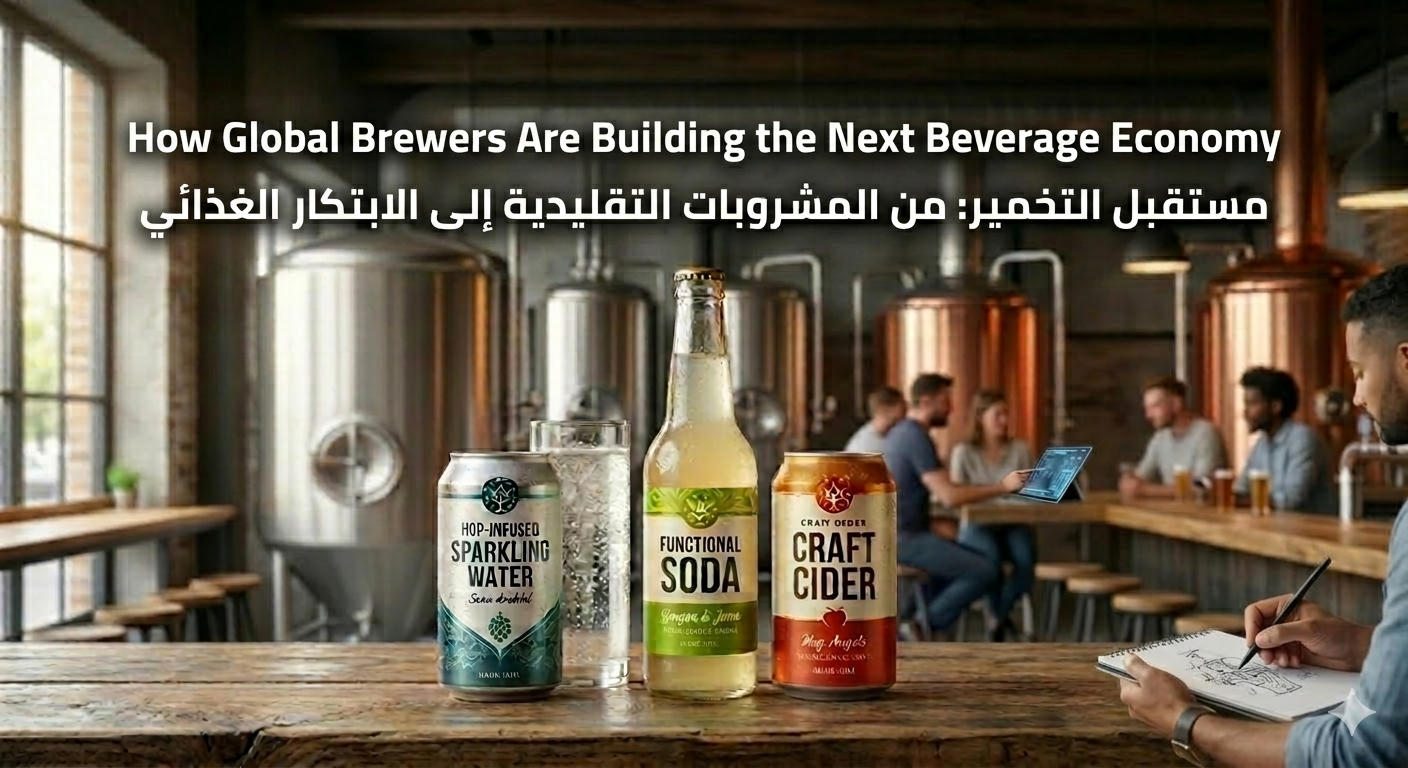


How Global Brewers Are Building the Next Beverage Economy
Global beer volumes fell again in 2025. Heineken's push into functional beverages — from electrolyte lagers to natural energy drink stakes — is not a product experiment. It is a structural pivot in what a brewer actually is.
"Once an industry loses default consumer behaviour, scale alone stops being enough. Relevance becomes the competitive advantage."
— Saudi FoodTech · Beverages & Industry Strategy, May 2026For most of the twentieth century, the beer industry ran on a simple formula: sell more volume, expand distribution, protect the lager. The growth logic was linear, the category boundaries were clear, and consumer behaviour was largely automatic — people drank beer because they always had.
That default is eroding. Global beer volumes declined again in 2025 across the world's leading markets, according to data from IWSR, the global authority on beverage alcohol. The category did not collapse — value held more resilient than volume, and premium and no-alcohol sub-segments continued to grow — but the structural shift is now visible at the strategic level. The industry's largest players are no longer asking how to sell more beer. They are asking what business they are actually in.
Heineken's recent moves — a minority stake in natural energy drink brand Tenzing, the launch of Heineken 0.0 Ultimate in the US and Europe, and the debut of Outd00r Brewing, an electrolyte-enriched isotonic lager — are the clearest current articulation of that question being answered in real time.
What the Data Is Actually Saying
The IWSR's preliminary data for 2025, covering the world's leading 21 markets, showed total beer volumes down −1% compared to the prior year. The declines were concentrated in large markets — the US, where consumption fell sharply partly due to a broader pullback in on-trade spending, and Brazil, facing macroeconomic pressure. Growth did occur: South Africa and India both advanced, and stout recorded solid gains in its core markets.
But the figure that carries the most strategic weight is the no-alcohol segment. While total beer volumes contracted, no-alcohol beer grew +8% by volume and +12% by value in 2024–2025. By 2025, 29% of no-alcohol beer volume sat in premium-plus price bands — up from 20% in 2019. In a declining category, that is an unusual distribution of growth.
The data is not saying consumers are abandoning beer. It is saying they are becoming far more selective about when they drink, what occasion justifies it, what price point feels worth it, and whether the product aligns with how they think about their own health and moderation.
The category has not lost its relevance. It has lost its automaticity. And those are very different problems requiring very different strategic responses.
The parallel to the trajectory of carbonated soft drinks is instructive. Coca-Cola never disappeared when consumers began questioning sugar and artificial ingredients — but the company had to compete far harder on occasion, reformulation, and portfolio diversification than it ever had before. Beer is entering a structurally similar phase. The question is whether the industry's biggest players move proactively or reactively.
IWSR data consistently shows beer category value holding more resilient than volume — driven by premiumisation and no-alcohol growth. Consumers are not abandoning beer entirely. They are drinking less of it, and trading up when they do. That distinction matters enormously for how a brewer constructs its commercial strategy.
Heineken's Strategic Response: Three Moves, One Direction
Heineken entered 2025 under its refreshed EverGreen 2030 strategy, unveiled at a Capital Markets Event in October 2025. The strategy is built around three pillars: accelerating growth, stepping up productivity, and future-proofing the business. The "future-proofing" element is where the functional beverage pivot sits — and three distinct moves in 2025 and early 2026 give it operational substance.
Move 1: Heineken 0.0 Ultimate. Launched in the US and Poland in March 2026 following a 2025 pilot, Heineken 0.0 Ultimate is the company's most explicit bid for functional beverage territory. Zero alcohol, zero sugar, zero calories — what the company itself calls a "triple zero" proposition. The product is positioned not primarily as an alternative for people who want beer without alcohol, but as a beverage that competes directly with sparkling waters, premium sodas, and functional hydration drinks. Heineken 0.0 is already present in 117 countries and has sold over 13 million cases in the US alone. The Ultimate line is the next layer: a clean-label, calorie-free extension aimed at consumers who have health goals and social lives they refuse to separate.
Move 2: Outd00r Brewing. Launched in the UK through Waitrose, Ocado, and David Lloyd gym locations in May 2026, Outd00r Brewing is Heineken's first venture into explicitly functional non-alcoholic beer. The product — stylised as Outd0.0.r, a reference to its 0.0% ABV — contains electrolytes, vitamin C, and magnesium, formulated for rapid fluid absorption and mineral recovery. It is deliberately positioned around the growing "active lifestyle" consumer segment: run clubs, sauna socials, post-gym socialising. This is not a branding exercise. The product competes structurally with isotonic sports drinks — a category with entirely different shelf neighbours and consumer motivations than traditional beer.
Move 3: The Tenzing Stake. In April 2025, Heineken UK took a minority stake in Tenzing, a natural energy drink brand founded in 2016 by former Red Bull executive Huib van Bockel. Tenzing had become the fourth-largest functional energy drink in UK grocery — 100% plant-based, low in calories, made with real fruit. The UK energy drinks market is valued at £2.2 billion and growing at 6% annually. Heineken's investment, which leaves Tenzing operationally independent, gives the brewer distribution leverage in the convenience channel, insight into the functional drinks consumer, and a commercial foothold in a category it did not previously occupy.
These three moves share a direction. Each one extends Heineken's addressable market beyond the traditional beer occasion. Each targets a consumer who is health-aware, values transparency around ingredients, and is choosing beverages around specific moments rather than out of habit. And each positions Heineken in a competitive space — functional hydration, electrolyte drinks, natural energy — where the competition is not Carlsberg or Molson Coors, but Red Bull, Lucozade Sport, and PRIME.
The Occasion Economy: Why "When" Has Become the Central Battle
The shift in consumer behaviour that underpins all of this is not simply about health. It is about the structure of consumption occasions. For decades, beer had a near-automatic claim on specific social moments: the post-work drink, the weekend socialising, the sporting event. Those claims are being contested, fragmented, and in some markets meaningfully eroded.
Younger consumers in many developed markets are drinking less frequently. When they do drink, they are more deliberate: they think about what fits the moment, what aligns with their health approach, and what feels worth the trade-off. When they do not drink, they want something that still fits the social context — something that is not water, not a soft drink marketed at children, and not a diet cola. This is the gap that no-alcohol beer has occupied so effectively. It is also the gap that functional beverages are now targeting from a different direction.
The strategic logic for Heineken is straightforward: own the occasion, not just the category. A brewer that can offer a post-run isotonic lager, a zero-calorie alcohol-free beer for a midday social, and a natural energy drink for the 3pm slump has a far more defensible commercial position than one that only competes at the bar.
This is portfolio diversification in its most commercially disciplined form — not brand extension for its own sake, but the deliberate construction of a beverage platform that follows the consumer across their day rather than waiting for them to choose beer.
RTD (ready-to-drink) expansion, premium positioning, and flavour experimentation are all visible in the industry's current response. But the deeper shift is the strategic one: the category is moving from ownership of a beverage to ownership of specific moments better than anyone else. That is a harder competitive battle to fight, but it is also one where genuine differentiation is possible in a way that pure volume competition is not.
Coca-Cola's transition from an automatic daily consumption product to a portfolio of occasion-specific beverages took years and significant portfolio investment. The beer category appears to be entering a structurally similar transition — later, but following the same logic. The brands that move early will have category relationships, consumer data, and distribution positioning that latecomers will pay heavily to acquire.
The Four Pivots Reshaping the Brewing Industry
Across the global brewing industry, the strategic response to shifting consumer behaviour is visible in four interconnected pivots. Heineken's recent moves are the clearest examples, but the pattern is industry-wide.
No-alcohol beer has moved from a niche concession to a growth engine. Heineken 0.0 is now in 117 countries. IWSR data shows no-alcohol beer volumes grew 8% in 2025 while total beer fell 1%. The segment is becoming structurally significant — and increasingly premium.
Electrolytes, vitamins, adaptogens, and recovery-focused formulations are moving from supplement brands into the beverage mainstream. Outd00r Brewing with magnesium and vitamin C is a first entry. The direction is clear: the beverage must do something beyond hydration and flavour.
Minority stakes in adjacent brands — as Heineken did with Tenzing — allow brewers to enter new categories with lower execution risk while retaining the founder energy and brand authenticity that large corporate ownership tends to dilute. This is venture logic applied to FMCG portfolio strategy.
The consumer is no longer the only target. The occasion is. Products are being positioned around specific moments — post-workout recovery, midday socialising, alcohol-free evenings — rather than purely around taste or brand heritage. Architecture follows consumer schedule, not shelf category.
These pivots are not happening independently. They reinforce each other. A brewer with strong no-alcohol credentials can extend into functional ingredients more credibly than one launching from a standing start. A distribution network built for beer becomes an asset for any adjacent beverage that needs to reach convenience and grocery channels quickly. The scale that once defined the industry's competitive moat is being redeployed in service of a different strategy.
What This Means for Emerging Markets and the MENA Region
The strategic dynamics playing out in Europe and North America carry direct implications for emerging and frontier beverage markets — including the GCC and broader Middle East, where the functional beverage opportunity is accelerating from a structurally different starting position.
In markets where alcohol is absent or marginal, the no-alcohol and functional beverage shift is not about moderation. It is simply about the beverage occasion itself. Health-aware urban consumers in Riyadh, Dubai, or Casablanca are navigating the same moment-based consumption logic — what fits this social context, what aligns with my health and wellness goals, what tastes premium enough to justify the price — without the alcohol question complicating the decision.
The GCC energy and functional drinks market has consistently outpaced global averages in growth, driven by a young demographic base, high urban density, a heat-driven hydration culture, and rising health awareness among younger consumers. Brands like Lucozade, Gatorade, and regional players have established distribution scale in modern trade. But the premium functional segment — plant-based, natural-ingredient, low-calorie — remains significantly underdeveloped relative to consumer demand signals.
Heineken's Tenzing investment, while currently focused on the UK market, points toward a model that has clear applicability in the region: a natural, functional, low-calorie drink that competes on ingredient transparency and lifestyle alignment rather than artificial energy. The distribution infrastructure that global brewers have built in non-alcoholic markets is an underutilised asset for this category.
For regional food and beverage operators, retailers, and investors, the question is not whether the functional beverage segment will grow. The structural conditions — demographics, health trends, modern trade expansion, rising disposable incomes — make that growth close to certain. The question is who will own the premium tier before the global players arrive with distribution scale and marketing budgets.
The broader point is that the strategic logic Heineken is executing in Europe — move from beer category to beverage platform, target occasions not just drinkers, integrate functional benefits into the product proposition — is entirely portable to markets where alcohol was never the starting point. In some ways, non-alcoholic markets are better positioned to benefit from this shift than markets still managing the transition away from alcoholic defaults.
- 1 The functional premium tier is largely uncontested. In most GCC markets, the no-alcohol premium and functional drink segment remains dominated by a small number of imported brands at price points that leave significant room for credible local or regional challengers.
- 2 Distribution infrastructure is the primary competitive asset. Any brand that can secure modern trade placement — supermarkets, hypermarkets, convenience formats — has a durable advantage in a market where physical retail still dominates FMCG purchasing decisions.
- 3 Occasion architecture translates directly. Post-workout, Ramadan socialising, sport viewing, office environments — all are high-frequency beverage occasions in GCC markets where the functional drink proposition aligns better than any alcoholic alternative ever could.
- 4 Global players are building the playbook now. The distribution lessons, product formulation investments, and marketing frameworks that Heineken and others are developing in Europe and North America will be deployed in emerging markets. Early local players have a window. It will not stay open indefinitely.
Conclusion: From Brewery to Beverage Platform
The beer industry is not in crisis. But it is in transition — and the brands that treat that transition as a product problem rather than a strategic one will find themselves defending shrinking volume share in a market where relevance, not scale, has become the primary competitive variable.
Heineken's moves in 2025 and early 2026 — Heineken 0.0 Ultimate, Outd00r Brewing, the Tenzing investment — are collectively a thesis statement about what the company believes a brewer needs to be in the next decade. Not a beer company with some no-alcohol options. A diversified beverage platform that competes across health, wellness, energy, hydration, and social occasions — wherever the consumer is, whatever moment they are navigating.
The IWSR data confirms the direction. Total beer volume falls. No-alcohol beer grows. RTDs grow. Value holds more resilient than volume because premiumisation continues. The consumer is not leaving the category. They are curating it. The brewers that curate with them will grow. The ones that wait for volume to return on its own are misreading the signal.