Nestlé Takes Full Control of yfood Labs
in €450 Million Deal
What started as a Munich startup solving the demand for convenient, nutritionally complete meals has become a strategic cornerstone for the world's largest food company — and a signal of where the entire industry is heading.
The Deal at a Glance
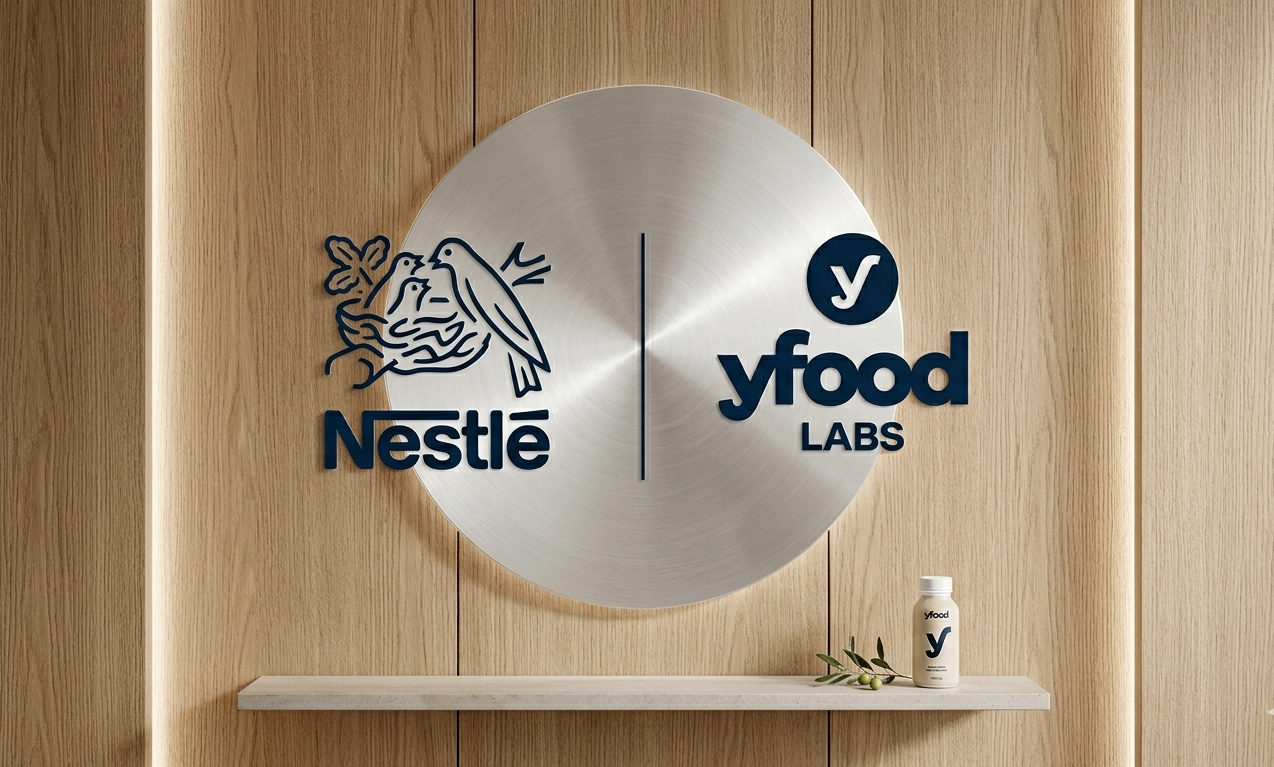
Nestlé has agreed to acquire the remaining shares of yfood Labs, the Munich-based nutritionally complete meal brand, from its founders Noel Bollmann and Benjamin Kremer. The transaction values the business at approximately €450 million and is expected to close by July 2026, subject to regulatory clearances.
Nestlé first acquired a 49% stake in yfood in 2023, establishing an initial partnership as the brand expanded its European distribution. The move to full ownership marks the first acquisition under CEO Philipp Navratil and reflects Nestlé's accelerating focus on functional nutrition, health science, and consumer wellness categories — segments that are structurally outperforming the company's legacy FMCG divisions.
Key Takeaways
- Nestlé acquires 100% of yfood Labs, valuing the brand at €450 million — roughly 3x its 2025 revenue of €150 million.
- The deal marks Nestlé's first acquisition under new CEO Philipp Navratil, signaling strategic continuity in health and nutrition investing.
- yfood's ready-to-drink meal products are now available in over 30 countries and more than 50,000 retail locations across Europe.
- The transaction follows Danone's acquisition of Huel earlier in 2026, confirming a structural shift among major food companies toward nutritionally complete meal platforms.
- For MENA markets, the convergence of food, health, and convenience mirrors rising consumer priorities across Saudi Arabia and the Gulf.
From Startup to Strategic Asset
Founded in 2017, yfood addressed a specific and underserved consumer need: a meal that is genuinely nutritious, convenient, and complete — without requiring preparation or compromise on health credentials. The brand's ready-to-drink format filled a gap that traditional FMCG companies had largely ignored, targeting a consumer cohort that was time-poor, health-conscious, and skeptical of conventional processed food.
The growth trajectory has been notable. yfood generated approximately €150 million in revenue in 2025, distributed across more than 30 European markets and over 50,000 retail touchpoints. That scale — built in under a decade — reflects both the underlying demand for the category and the accelerant effect of Nestlé's distribution and commercial infrastructure following its initial investment in 2023.
The Strategic Logic for Nestlé
Nestlé is the world's largest food and beverage company, headquartered in Vevey, Switzerland, with a portfolio spanning coffee, dairy, petcare, infant nutrition, and health science. Over the past several years, the group has deliberately rotated capital toward higher-growth, margin-accretive categories — and functional nutrition sits squarely at the intersection of those priorities.
The yfood acquisition is not an opportunistic buy. It is a deliberate move to own — rather than merely distribute — a brand in one of the fastest-evolving segments of consumer health. Nutritionally complete meals, protein-focused nutrition, gut health solutions, and GLP-1 adjacent products are attracting disproportionate consumer and investor attention. Nestlé's full consolidation of yfood places the company at the forefront of that structural shift.
"Nutrition is no longer a niche category within FMCG. It is becoming a core growth engine — and the companies acquiring in this space today are positioning for the next decade of consumer health spending."
Saudi FoodTech — Editorial Analysis, June 2026Under full Nestlé ownership, yfood is expected to accelerate its geographic expansion beyond its existing European footprint. The brand's operational model — asset-light, DTC-capable, and with strong retail penetration — is well-suited to international scaling, and Nestlé's global logistics and market access capabilities provide a significant runway.
A Broader Industry Realignment
The Nestlé-yfood deal does not exist in isolation. Earlier in 2026, Danone acquired Huel — another high-growth nutritionally complete brand — in a transaction that sent a clear signal across the industry. Two of the world's largest food conglomerates, within months of each other, made major commitments to the same emerging category. That is not coincidence. It is convergence.
Across the consumer health spectrum, similar dynamics are at play. Categories such as meal replacements, high-protein nutrition, functional beverages, gut health platforms, and weight management solutions — particularly those with clinical or GLP-1 related positioning — are commanding premium valuations and attracting sustained investment from both strategic acquirers and private equity. The implicit message is unmistakable: convenience plus health credentials equals defensible growth.
For the traditional FMCG industry, this creates a competitive imperative. Brands that cannot demonstrate functional benefits, clean-label credentials, or a credible wellness narrative face structural de-rating risk, regardless of their revenue scale. Acquiring high-growth nutrition brands is, in part, a hedge against that risk.
"CConsumers are increasingly looking for products that combine nutrition, functionality, and ease of use. yfood has built exactly that — a brand with strong health credentials, real convenience, and the scale to expand. This is precisely the kind of asset we want to own fully."
What This Means for MENA and Saudi Arabia
The trends driving the Nestlé-yfood transaction are not unique to Europe. Across Saudi Arabia and the wider Gulf region, consumer priorities are undergoing a parallel shift. Health awareness is rising sharply, driven by government public health initiatives, the normalization of gym culture and wellness lifestyles, and growing consumer fluency with nutritional science. The demand for functional, convenient, and nutritionally credible products is accelerating — and the market infrastructure to support it is maturing.
Saudi Arabia's food sector, under Vision 2030, is also undergoing structural transformation. Domestic food manufacturing is being incentivized, import dependency is under policy scrutiny, and there is growing appetite for health-focused product categories among Saudi consumers — particularly among the country's large and digitally active youth demographic. Functional nutrition, meal replacement platforms, and science-backed wellness products are all categories with meaningful medium-term growth potential in the Kingdom.
The yfood model — a brand built on health credentials, convenience, and transparent nutritional positioning — is precisely the type of product that resonates with evolving MENA consumer expectations. While yfood's direct presence in the region remains limited, Nestlé's full ownership and international expansion agenda may well place the brand in Gulf markets within a shorter timeframe than previously anticipated.
The Valuation Signal
At an implied valuation of €450 million against €150 million in 2025 revenue, yfood commands a 3x revenue multiple. For context, this is significantly above the valuation multiples typically applied to conventional FMCG businesses — a premium that directly reflects the category's growth trajectory, the brand's defensibility, and Nestlé's strategic appetite to control the asset outright.
The willingness to pay that premium — particularly as Nestlé navigates broader portfolio pressures and investor scrutiny — is itself a signal. It communicates that the company's leadership views nutritionally complete meal platforms not as a peripheral bolt-on but as a foundational growth pillar. That conviction will shape how the industry allocates capital in the years ahead.
"The acquisition of yfood reflects a clear strategic direction: we are building for the future of food, where health, science, and everyday convenience converge. This is not about one brand — it is about the direction of the entire category."
Editorial View
The Nestlé-yfood transaction is a clean illustration of where the global food industry's centre of gravity is shifting. The era of diversified portfolios anchored by commodity processing is giving way to a model where innovation density, health credentials, and consumer relevance are the primary drivers of valuation and strategic priority. Nutritionally complete meals are no longer a niche — they are a mainstream growth category, and the world's largest food companies are racing to own the leading positions within it.
For investors, operators, and strategists across Saudi Arabia and the MENA region, this transaction carries direct relevance. The consumer trends underpinning yfood's growth — health-consciousness, time scarcity, demand for functional products — are playing out in the Gulf with equal if not greater intensity. The question is not whether this category will grow in the region, but which brands, retailers, and local manufacturers will be positioned to capture that growth when it accelerates.